Pink Roses Flower Pot Embroidery Design
First Impressions: Graceful, Grounded, and Ready for Real Life
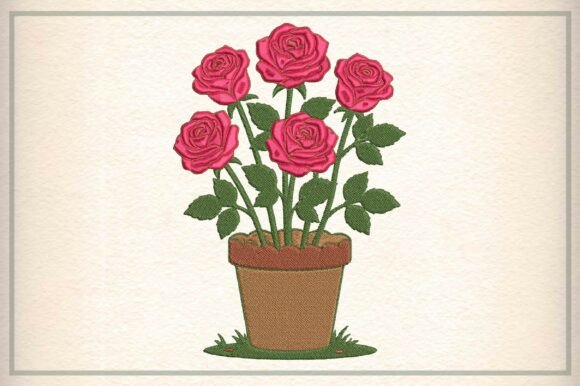
When I opened the Pink Roses Flower Pot Embroidery Design, my immediate thought wasn’t “pretty”—it was “purposeful.” This isn’t just a floral cluster tossed onto a hoop; it’s a composed vignette. The roses bloom with gentle asymmetry, the planter anchors the composition, and those rich green leaves don’t just fill space—they create rhythm and depth. It feels like something you’d stitch for a friend who appreciates quiet elegance over flash. As a designer who’s reviewed hundreds of floral machine embroidery designs, I appreciate how this one avoids visual clutter while still delivering detail—no tiny, un-stitchable petals or overwrought stems. It belongs squarely in the Floral Garden category, yes—but more specifically, it’s built for wearability, gifting, and small-batch production.
A Real-World Test: Embroidering It on a Linen-Cotton Kitchen Towel
Last week, I used the Pink Roses Flower Pot Embroidery Design on a set of custom tea towels for a local café’s Mother’s Day pop-up. Why a towel? Because it’s unforgiving: medium-weight fabric, slight texture, frequent washing, and zero room for sloppy satin stitch edges or floating threads. I hooped it with medium tear-away stabilizer, matched thread colors to soft rose pinks and sage greens (no neon here), and ran it at standard speed. The result? Clean leaf veins, smooth petal curves, and a planter edge that held its shape without puckering. Customers didn’t just say “cute”—they paused, traced the outline with their fingers, and asked, “Who made this?” That’s the quiet power of a well-balanced embroidery file: it elevates the handmade product without shouting.
Where It Shines—and Where It Needs Thought
The Pink Roses Flower Pot Embroidery Design excels on stable, medium-weight fabrics: tote bag canvas, cotton sweatshirt fleece, pillow covers, aprons, and baby onesies. On a structured cap front? It works—if you use cut-away stabilizer and avoid stretching the curve too far. As an embroidered patch, it holds up beautifully when backed properly. For custom apparel, it reads clearly at 3.5–4 inches wide—ideal for left-chest placement or sleeve accents.
But be mindful: on thin or stretchy fabric (like lightweight knits or rayon blends), the fill stitch density may cause distortion unless you add light iron-on stabilizer underneath. On dark fabric, test your thread contrast first—the palest pink thread can disappear against charcoal or navy. And skip it for tiny hoops under 4x4 inches unless you’ve confirmed the design scales cleanly; those delicate leaf tips and planter contours need breathing room.
What It Adds to Your Craft Business—Beyond Aesthetics
If you’re an Etsy seller, a boutique owner, or a craft business launching holiday embroidery kits, this design quietly strengthens your brand. It reads as intentional, not generic. That matters when customers scroll past dozens of floral options—they’ll remember the one that looks *designed*, not assembled. For personalized gifts, it pairs naturally with monogrammed initials or subtle dates (“Est. 2024”) without competing. And because it’s rooted in timeless garden symbolism—not trends—it stays relevant across seasons and customer age groups.
It also builds customer trust. When someone receives a sweatshirt with this stitched cleanly on the back yoke, they feel the care in the placement, the evenness of the satin stitch on the petals, the thoughtful spacing between leaves. That perception translates directly to reviews, repeat orders, and word-of-mouth referrals.
Practical Designer Notes You’ll Actually Use
- Always test first—run the Pink Roses Flower Pot Embroidery Design on scrap fabric matching your final project’s weight and stretch.
- Check stitch density before scaling down; dense fill areas may need reduced density settings on lightweight materials.
- Confirm hoop size compatibility—if your machine uses smaller hoops, verify the design fits without auto-trimming critical details.
- Inspect small details in your embroidery software: look for tight corners on the planter rim or overlapping leaf layers that might cause thread breaks.
- Test black-and-white mockups—this design relies on tonal contrast, not just color, so ensure it reads well in grayscale previews for listings or catalogs.
- Use proper stabilizer—medium tear-away for stable wovens, cut-away for knits or layered garments like reversible aprons.
- Review licensing before selling finished items or bundling the digital embroidery file—some versions allow commercial use; others don’t. Don’t assume.
Final Thought: Not Just a Design—A Reliable Creative Partner
I keep returning to the Pink Roses Flower Pot Embroidery Design because it behaves. It doesn’t surprise me mid-stitch with tangled jump stitches or misaligned elements. It adapts—whether I’m digitizing it for a printable mockup, resizing it for a baby bib, or pairing it with hand-lettered text on a holiday gift tag. It’s not flashy, but it’s dependable. And in the daily work of running a small shop product line or fulfilling client requests for wedding gifts or nursery decor, dependability is everything. If you’re selecting embroidery assets for long-term use—not just one-off projects—this one earns its place in your core design assets library.