Unicorn Face with Flowers Embroidery
A Designer’s First Look: Charm Without Clutter
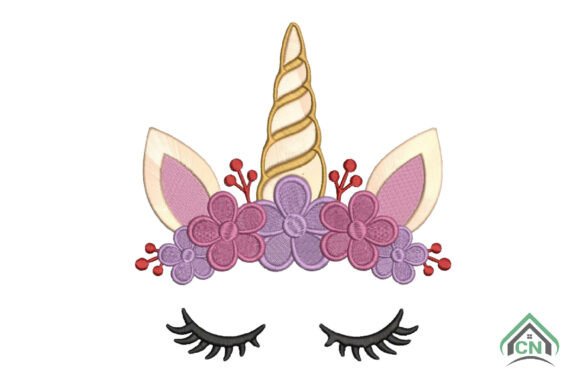
When I opened Unicorn Face with Flowers Embroidery, what struck me wasn’t just the whimsy—it was the balance. This isn’t a busy, over-layered fairy tale motif. It’s a centered, expressive unicorn face framed by soft, organic flower shapes—no sharp edges, no fussy symmetry. The layout breathes. That matters when you’re stitching on a curved surface like a baby onesie or a tapered tote bag strap. As a designer who’s stitched hundreds of custom pieces for Etsy sellers and boutique clients, I immediately saw its versatility: it reads clearly at 3.5 inches wide but holds up beautifully scaled to 5 inches for a pillow cover or nursery wall hanging.
Where It Shines in Real Projects
I recently tested Unicorn Face with Flowers Embroidery on a medium-weight cotton twill tote bag for a local children’s boutique—and it landed perfectly. The satin-stitched horn caught light just right; the fill-stitched petals retained soft definition without puffing or bleeding. On sweatshirt fabric? With proper cutaway stabilizer underneath, it stayed crisp. On a lightweight tea towel? I reduced stitch density slightly (a quick edit most modern machines allow) and added tear-away on top—no puckering, no shadowing. For baby embroidery, the rounded contours and absence of tiny detached elements make it inherently safe and wash-durable. It also translates well into an embroidered patch: clean outer edge, minimal underlay, and enough internal contrast to read even when heat-applied.
What You’ll Want to Watch For
This design leans into delicacy—and that’s both its strength and its boundary. On highly textured fabrics like bouclé or thick terry cloth, the finer floral details can disappear unless you adjust needle penetration depth or use a slightly heavier thread weight. On stretchy knits (think toddler leggings or fitted tees), skip direct hooping—use a light iron-on stabilizer *and* baste the fabric taut to avoid distortion around the unicorn’s eye or flower centers. Dark fabric demands attention too: test your chosen thread colors against black or navy first. Some pale pinks or lavenders in the flower palette may mute unless you switch to high-contrast variegated threads or add a subtle white outline stitch (if your machine supports editing). And while it works on caps, avoid placing it too close to the bill curve—the lower jaw line and smallest petal clusters need flat real estate to stitch cleanly.
Design Integrity Meets Customer Trust
When a customer orders a personalized gift—a birthday sweatshirt, a newborn’s blanket, a holiday apron—they’re buying more than thread and fabric. They’re buying intention, care, and visual harmony. Unicorn Face with Flowers Embroidery delivers that quietly. Its gentle scale and cohesive flow signal handmade quality—not mass-produced clip art. I’ve seen buyers pause mid-scroll on Etsy listings when this kind of design appears in a mockup: it feels intentional, not decorative filler. That pause builds trust. For craft businesses, that means higher perceived value, fewer “Is this really hand-embroidered?” questions, and smoother branding across product lines—from nursery decor to summer camp totes.
Practical Notes Every Embroiderer Should Run Through
- Always test first—on scrap fabric matching your final project’s weight and stretch.
- Check thread color contrast on both light and dark backgrounds before committing to a full run.
- Review stitch density: dense fill areas near the unicorn’s mane or flower centers may benefit from slight reduction on delicate fabrics.
- Confirm hoop size compatibility—this design fits comfortably in a 4x4 hoop, but verify before loading if you’re working with compact machines or tight garment seams.
- Inspect small details in the digital embroidery file: are petal tips and eyelash accents digitized as running stitches or micro-satins? That affects clarity on fine fabrics.
- Test black-and-white mockups—they reveal contrast issues invisible on screen.
- Use appropriate stabilizer: cutaway for knits and wearables, tear-away for stable wovens, and fusible + tear-away combo for lightweight linens.
- Verify licensing terms before selling finished products or bundling the embroidery file in digital kits—especially important for Etsy sellers and digital product shops.
Why It Fits Seamlessly Into Your Creative Workflow
This isn’t a one-off novelty. Unicorn Face with Flowers Embroidery is a reliable, mood-aligned asset—ideal for seasonal collections (spring baby showers, summer camp gear), evergreen handmade products (nursery pillows, girl’s backpacks), and brand-consistent merchandise (a boutique’s signature tote, a maker’s limited-run apron line). Its Fairy Tales category placement makes sense, but don’t box it in: paired with neutral typography or minimalist borders, it elevates rather than dominates. As a commercial embroidery designer, I keep it in my go-to folder for clients who want charm without cliché—where “magical” means thoughtful execution, not glitter overload.
Final Thought: It’s Not Just Pretty—It’s Purposeful
In a market flooded with overly complex unicorn motifs, Unicorn Face with Flowers Embroidery stands out by respecting the craft. It doesn’t ask for special hoops, exotic threads, or hours of editing. It asks for attention—to fabric choice, stabilizer pairing, and context. When stitched well, it looks like something made with care, for someone specific. And that’s the quiet power behind every successful handmade product, every repeat Etsy buyer, every small shop that grows because customers feel seen. Use it intentionally, test it honestly, and let the design do what it does best: enchant without effort.