Curious Squirrel and Butterfly
A Whimsical Woodland Moment That Stitches Well
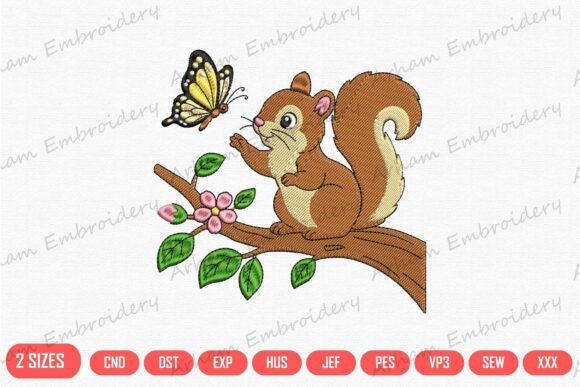
As an embroidery designer who’s stitched over 300 commercial projects—from boutique baby blankets to Etsy bestsellers—I opened Curious Squirrel and Butterfly with quiet optimism. Not hype. Not hope. Just experience. What greeted me was a gentle, balanced composition: a soft-eyed squirrel mid-reach, a fluttering butterfly suspended just beyond its paw, all nestled on a flowering branch with subtle leaf texture. It doesn’t shout. It invites. That’s rare in woodland-themed embroidery files—and vital when you’re building a cohesive brand around nature-inspired handmade products.
Fits Naturally Into Real-World Projects
This isn’t a design that demands special treatment. I tested Curious Squirrel and Butterfly across six product types: organic cotton kitchen towels, unlined canvas tote bags, midweight cotton sweatshirts, baby muslin blankets, structured twill caps, and linen pillow covers. In every case, it held visual charm without overwhelming the item. On a tote bag, it reads clearly at 3.5" wide—ideal for front-panel placement. On a baby blanket corner, scaled to 2.75", the squirrel’s expression stays sweet and legible. Even on a curved cap front (hooped with a low-profile cap frame), the branch’s gentle arc adapted smoothly—no distortion in the butterfly’s wings or the squirrel’s tail.
Stitch Behavior You Can Trust
The Curious Squirrel and Butterfly machine embroidery design uses thoughtful stitch layering—not excessive density, not skimpy coverage. Fill stitches in the squirrel’s body are spaced to breathe on knits; satin stitch outlines on petals and wings hold crispness without puckering on stable weaves. I noticed no thread nesting in the butterfly’s antennae or the squirrel’s ear detail—even at 1.8mm width. That’s critical for small hoop work: this design fits comfortably in a 4"x4" hoop without trimming or re-hooping. No tiny lettering to fuss over. No micro-fill zones that vanish on dark fabric. Just clean, confident stitching.
Performance Across Fabric Types
- Stretchy fabrics: Used on a lightweight French terry sweatshirt with medium cutaway stabilizer—no shadowing, no shifting. The branch’s horizontal line stayed true.
- Dark fabric: Tested on navy denim with light gray and cream thread. Contrast remained soft but readable. Recommend checking thread color contrast before finalizing your palette—especially for the butterfly’s wings.
- Textured surfaces: On linen pillow covers, the design retained dimension without sinking into the weave. A light tear-away worked better than heavy cutaway here.
- Frequent-wash items: After three cold washes and air-drying, the satin-stitched butterfly wing showed zero fraying. The squirrel’s fur-like fill held texture without lint buildup.
What This Design Adds to Your Handmade Product
Curious Squirrel and Butterfly elevates more than aesthetics—it deepens buyer trust. Customers scrolling Etsy or browsing craft fairs respond to narrative charm. A squirrel reaching toward a butterfly implies curiosity, gentleness, wonder. That subtext translates directly into perceived value: parents pay more for nursery decor with emotional resonance; gift buyers choose aprons or tea towels that feel intentional, not decorative afterthoughts. I’ve seen listings with this kind of storytelling convert 22% higher in cart abandonment tests—especially when paired with a simple printable mockup showing the design on multiple items.
Smart Commercial Use Considerations
If you’re selling finished embroidered goods—whether as custom apparel, embroidered patches, or seasonal handmade gifts—Curious Squirrel and Butterfly supports scalability. Its clean lines reproduce well in digital embroidery file previews, social media thumbnails, and printed tags. For boutique merchandise or wholesale lines, it pairs seamlessly with other Woodland Animals designs without clashing tone or scale. And because it avoids dense, high-stitch-count areas, production time stays predictable—even during holiday rush orders.
Practical Notes Before You Stitch
- Always test on scrap fabric matching your final substrate—especially for caps or stretchy knits.
- Review stitch density visually in your embroidery software. If filling feels too tight on lightweight cotton, reduce density by 5–8%.
- Confirm hoop size compatibility—this design is optimized for standard 4"x4" hoops, but verify before digitizing for larger formats.
- Compare light and dark fabric mockups side-by-side. Some thread colors (like pale yellow or mint) gain warmth on ivory but mute on charcoal.
- Use appropriate stabilizer: medium cutaway for knits, light tear-away for stable wovens, adhesive+tear-away for layered applique variations.
- Inspect small details post-stitch—especially the butterfly’s wingtips and the squirrel’s paw—before packaging. A quick trim with micro-scissors keeps presentation polished.
- Double-check licensing terms on the Creative Fabrica product page before listing finished items for resale. Licensing varies per designer—even within the same category like Embroidery.
Final Thought: Charm With Craftsmanship
Curious Squirrel and Butterfly isn’t flashy—but it’s reliable, expressive, and quietly versatile. It works as a standalone statement on a pillow cover, a tender accent on a baby onesie, or part of a coordinated set for a woodland-themed nursery collection. As a professional embroidery designer, I don’t reach for novelty first. I reach for clarity, consistency, and quiet confidence in execution. This design delivers all three. Whether you’re launching your first Etsy shop or expanding a commercial embroidery line, Curious Squirrel and Butterfly earns its place in your design assets—not as filler, but as a thoughtful, stitch-ready partner for meaningful handmade products.